






Reef Ecology Guide Phuket Thailand - Bony Fishes 2
TREVALLIES (Carangidae)

A large tropical to temperate family, compromising approximately
25 genera and 140 species globally. Many are pelagic and wide-ranging,
some enter brackish water. Many of the post-larval stages swim with
floating objects or weed rafts, taken well beyond their normal range.
The trevallies are streamlined fast swimming, usually schooling,
fishes. Carnivorous, smaller species feed on zooplankton and larger
species feeding on other fishes such as pilchards or herring type
species. The larger species are tuna-like, growing to 2 m long and
a weight of 80 kg.
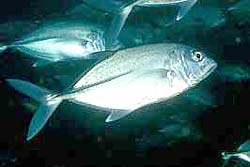
BIG-EYE TREVALLY (Caranx sexfasciatus)
 Length:
to 1 m
Length:
to 1 m
A very common species in our area, often in great schools at the Similan Islands.
Small juveniles are marked with dark cross bars. Large adults are found singly or in schools along deep drop-offs.

SNAPPERS (Lutjanidae)
A large family with about 100 species world wide. Snappers live
in most benthic habitats and many species change their life style
with growth, and often change as juvenile from estuarine or freshwater
to adult in a full marine environment.
All are carnivorous, feeding
on small fishes and invertebrates, either benthic or planktonic.
Behavior varies greatly in the family. They occur singly or in schools
between size and species.
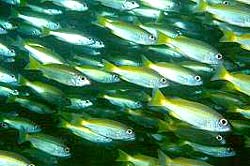
BIG-EYE SNAPPER (Lutjanus lutjanus)
 Length:
to 35 cm
Length:
to 35 cm
Found on exposed reefs of continental shelves, but absent from oceanic islands.
Often seen in schools together with other snapper species on Day Trips around Phi Phi Island.
SWEETLIPS (Haemulidae)
A widespread, large family with an estimated 120 species in about
18 genera. The taxonomy was in a confusing state because of very
different phases between juveniles and adults some of which were
only recently linked.
Sweet lips are mostly reef dwellers, sheltering
in caves or shipwrecks during the day, and feeding mainly at night
over sand and rubble in search of benthic invertebrates. They occur
singly or in groups, depending on the species or area and are pelagic
spawners. Small juveniles are solitary, and have their own unique
color pattern.
Most swim close to the substrate in an unusual way
by waving the tail in an exaggerated manner. The adults differ from
related or similar fish by its small mouth with thick lips. Other
features are small scales, strong fin spines and a large head.
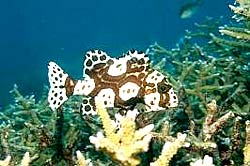
HARLEQUIN SWEETLIPS (Plectorhinchus chaetodontoides)
 Length:
to 60 cm
Length:
to 60 cm
Large juveniles and adults may share large ledges and caves along drop-offs. Small juveniles are found in protected bays and lagoons.
Dramatic changes from juvenile, brown with large white patches, to intermediates with large black spots.
The spots reduce in size with age and large adults have small spots over most of the body and head.
ORIENTAL SWEETLIPS (Plectorhinchus vittatus)
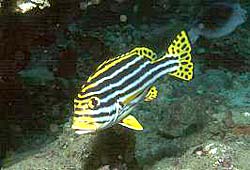 Length:
to 50 cm
Length:
to 50 cm
Adults occur in schools in clear water on outer lagoons and reef slopes.
They are not shy towards divers, but juveniles hide among coral branches.
BATFISHES (Ephippidae)
A small but interesting family of 5 known species. Adult fishes
can be found from coastal lagoons to outer reefs where they may
form large schools. They are thought to be pelagic spawners.
Batfishes feed in daytime and are not shy towards divers. Their diet consists
of algae and a variety of invertebrates such as jellyfish or plankton.
ROUND BATFISH (Platax orbicularis)
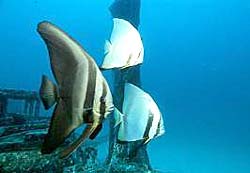 Length:
to 60 cm
Length:
to 60 cm
Widespread throughout our area from surface to 40 m.
Smalljuveniles float against the surface with current or wind-driven land debris. They settle in lagoons or along beaches on sand in small schools.
Adults pair or school in different areas and are usually found in deeper off shore areas.
BUTTERFLYFISHES (Chaetodontidae)
A large family of colorful fishes. It comprises 10 genera with
about 120 species which mostly inhabit coral reefs. Most species
occur in shallow depths on coral reefs, many of which in pairs or
in schools.
Their diet consists of small invertebrates, which are
usually picked from the substrate, except those adapted to zooplankton. Their high, flat bodies are ideal build to maneuver between corals. They are active in daytime. By night they seek for shelter between corals and take a dark coloration.
RED-TAILED BUTTERFLYFISH (Chaetodon collare)
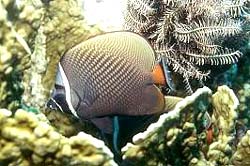 Length:
to 14 cm
Length:
to 14 cm
Inhabits outer reef slopes and rocky shores, also found in coral-rich areas. Feeds mainly on coral polyps and worms.
In pairs, also often in schools of up to 25 individuals. Not shy towards divers.
SCHOOLING BANNERFISH (Heniochus diphreutes)
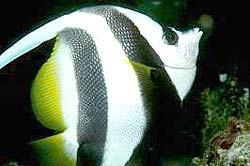 Length:
to 20 cm
Length:
to 20 cm
This widespread species is found in sometimes large aggregations in the water column high above reef tops, feeding on zooplankton.
Juveniles live a more bottom-oriented existence, while adults spend all day in open water, where they are protected by swimming in a school.
ANGELFISHES (Pomacanthidae)
This family comprises some of the most beautiful reef fishes, comparable
to the butterfly fishes, however they are generally larger and more
majestic. They are readily distinguished from the closely related
butterfly fishes by the large spine on the lower corner of the gill
plate.
Angelfishes are territorial. They have the most dramatic
different colored juveniles imaginable, not even slightly relating
to the adults. Most species have very different color patterns between
sexes.
Angelfishes feed on algae, sponges and corals, including
the associated invertebrates. These fishes can produce low frequency
drum-like or thumping noises, and when produced by the large species,
so loud that it can startle a diver.
RING ANGELFISH (Pomacanthus annularis)
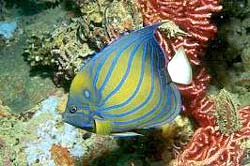 Length:
to 50 cm
Length:
to 50 cm
Large, impressive Angelfish, which prefers murky, nutrious-rich habitats. Feeds on zooplankton and sponges. Adults are found mostly in pairs in depths of 20 m or more.
EMPEROR ANGELFISH (Pomacanthus imperator)
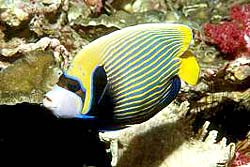 Length:
to 40 cm
Length:
to 40 cm
This species lives near ledges and caves in areas of rich coral growth in clear lagoons, channels and seaward reefs, encountered singly or in pairs.
PARROTFISHES (Scaridae)
A large tropical family of medium sized fishes which are characterized
largely by their teeth, one group the jaws with numerous conical
teeth, the other fused teeth into plates, beak-like similar to parrots,
hence their common name.
The majority of species feed by scraping
algae off dead coral rock or rubble and sand. In the process much
of the coral surface is crushed and digested. They produce vast
quantities of sand this way which often is released during displays
and swimming over reef-crests. As these fishes occur abundantly
on coral reefs, often feeding in densely packed large schools, they
are an important component in the reef building process.
Parrot fishes are protogynous hermaphrodites. After the juvenile phase
they develop into females, later into males with a completely different
color pattern, usually a mixture of brilliant contrasting colors
with blue and green dominating.
BLUE-BARRED PARROTFISH (Scarus ghobban)
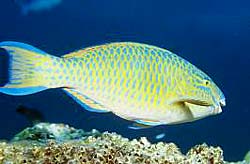 Length:
to 80 cm
Length:
to 80 cm
One of the largest in the family. Common in various habitats, also deep, penetrating silty environments more readily than other parrot fishes. The dental plates are pale pink. We see them often at our Similan Liveaboard cruises.
EMBER PARROTFISH (Scarus rubroviolaceus)
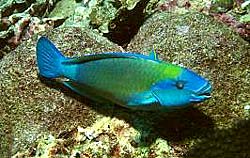 Length:
to 70 cm
Length:
to 70 cm
This species inhabits lagoons and seaward reefs, encountered singly or in harem groups. Adults sometimes mix with other parrotfishes to feed in schools.
SURGEONFISHES (Acanthuridae)
A large circumtropical family, featuring a single fixed spine on
each side of the caudal peduncle, some of which are venomous. The
spine is not hinged, but when used in defense or when fighting,
the tail is bent which makes the spine stick out.
Diet varies between species, some graze on algae, feed on zooplankton or both. Others filter food from the substrate by digesting sand. Planktivorous
species often school in great numbers. Reef dwelling species are
often very colorful. The spines on the tail are often surrounded
by bright colors to serve as a warning.
POWDER-BLUE SURGEONFISH (Acanthurus leucosternon)
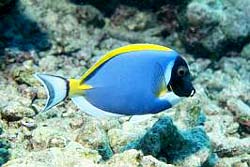 Length:
to 25 cm
Length:
to 25 cm
Typical surgeonfish, found from inshore surge zones to offshore reef flats like the Similans and slopes.
Snorkeler can also enjoy the whirling blue fish in a depth of only one meter at some places.
LINED SURGEONFISH (Acanthurus lineatus)
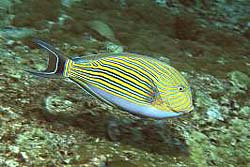 Length:
to 35 cm
Length:
to 35 cm
Widespread species, usually found in very shallow depths, schooling over reef crests, rarely deeper than 6 m.
An easily identified species by its color pattern. Large males are territorial and control well-defined feeding territories and harems in the surge zone.
BARRACUDAS (Sphyraenidae)
The Barracuda family comprises 1 genus and about 20 species globally
distributed. They are efficient predators, feeding mainly other
fishes and squid. Their bodies are streamlined and the large mouth
is equipped with powerful jaws and saber-like teeth.
Most of their hunting is done during dusk and dawn, though they appear to patrol the reefs on the look-out to take advantage of any opportunity for an easy feed. Some species are large, reaching more than 1 m in length and the great barracuda attains almost 2 m.
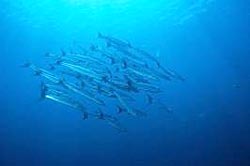 Length:
to 1,3 m
Length:
to 1,3 m
Home |
Liveaboard Cruises |
Day Trips |
Diving Courses |
PADI IDC - CDC |
TEC Diving |
Dive&Save |
Reef Guide |
Phuket Guide |
About Dive Asia |
FAQ |
Links |
Contact us


Dive Asia - Phuket Thailand
Office Address: 23/6 Karon Rd, Kata Beach, Phuket 83100, Thailand
Phone: +66 (0) 76330598
Visit us at one of our Offices: (Google Map)
Email:
Website: www.diveasia.com
24 Hour Hotline: +66 (0) 818948588