






Reef Ecology Guide Phuket Thailand - Cartilaginous Fishes
CARTILAGINOUS FISHES (Chondrichthyes)

All sharks and rays belong to the class of cartilaginous fishes.
Their skeleton is built of hardened cartilage, as opposed to bone.
The body muscles are joined to the spine by connective tissues.
All cartilaginous fishes are carnivores. They have electro-sensitive
pores on their head to track down their prey. Cartilaginous fishes
reproduce partly oviparous, partly viviparous. Unlike bony fishes,
fertilization of the eggs happens inside the females. Compared with
bony fishes, cartilaginous fishes reproduce slowly with long gestation
periods (viviparous), or with only a small quantity of eggs (oviparous).
Many species of cartilaginous fishes, in particular sharks, are
endangered. Every year, tens of millions die in floating nets and
in the commercial hunt for shark fins. The shark fin soup industry
is perhaps the sharks biggest greatest enemy, and unless consumers become
educated, many species of shark may soon be extinct.
Sharks
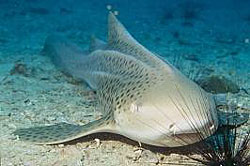
LEOPARD SHARK (Stegastoma fasciatum)
 Length:
to 3 m
Length:
to 3 m
An unmistakable shark, frequently encountered in coral reefs and lagoons around Phuket and the Similan Islands. Its caudal fin is almost as long as its body. Often called a Zebra Shark.
During the day the Leopard Shark is usually seen resting motionless on the bottom. During the night this nocturnal hunter swims around to find its prey of crustaceans, shelled invertebrates and small fishes.
Most frequently seen shark at all dive sites in the Andaman Sea.
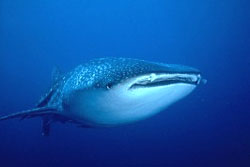
WHALE SHARK (Rhincodon typus)
 Length:
to 18 m
Length:
to 18 m
The largest fish in the ocean, this giant is easily recognized by its immense size and a two-tone pattern of light spots and lines on a dark brown dorsal surface.
The enormous mouth can be opened very wide to filter large amounts of water for small fish and plankton.
Whale Sharks are viviparous. Their hatchlings are about 70 cm long at birth. Only very little is known about the habits of Whale Sharks.
Recently, they have come under severe hunting pressure for their fins. Whale Sharks are one of the top attractions in the Similan Islands from November to April.
TAWNY NURSE SHARK (Nebrius ferrugineus)
Length: to 3 m
Nocturnal, resting in caves or large ledges in daytime, often in groups. Only occasionally moving about during the day. Often seen during day trips around Phuket and at the Similan Islands.
A large, sluggish species with nasal barbels to track down prey. Feeds primarily on cephalopods, sea urchins and fish.
BLACKTIP REEF SHARK (Carcharhinus melanopterus)
Length: to 2 m
Usually seen in small groups on reef tops around Phi Phi Island and the Similans, hunting for fish. It readily enters very shallow and even brackish waters.
The species is easily identified by its distinct fin tips, which often protrude from the shallow water.
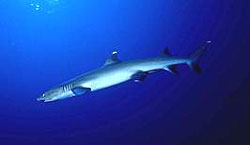
WHITE-TIP REEF SHARK (Triaenodon obesus)
 Length:
to 2 m
Length:
to 2 m
Likely the first shark encountered on reefs around the Similans.
The common species is seen singly or in small groups in the reef, resting on the bottom or in caves by day, hunting fish among the corals at night.
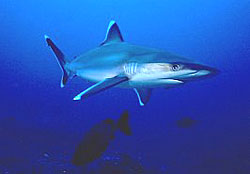
GREY REEF SHARK (Carcharhinus amblyrhynchos)
 Length:
to 2 m
Length:
to 2 m
One of the most popular sharks in general.
Grey Reef Sharks are curious and readily approach divers, sometimes showing territorial behavior: hunching the body, lowering the pectoral fins and swimming in an exaggerated manner.
They feed on bony fishes mainly between dusk and dawn.

RAYS
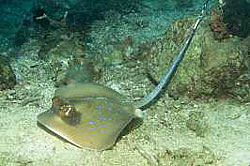
KUHLS STINGRAY (Dasyatis kuhlii)
 Width:
to 40 cm
Width:
to 40 cm
Widespread species and seen around Phuket, Phi Phi Island and at the Similan Islands, living on vast sand flats, by day often buried in the sand.
It has a caudal fin fold, and usually two stings set midway on the tail. Tip of tail distinct. Often mistaken as Blue Spotted Ribbontail (Taeniura lymma).
BLOTCHED FANTAIL RAY (Taeniura meyeni)
Width: to 2 m
Most common Stingray species around Phuket, Phi Phi Island and at the Similan Islands. The species is encountered along the base of drop-offs or on sand flats in or near coral reefs.
By blowing into the substrate, the ray dislodges mollusks and crustaceans from the sand, which are taken up and eaten.
Not being shy, this large ray is a good photographic model.
SPOTTED EAGLE RAY (Aetobatus narinari)
Width: to 3 m
This species is easy to recognize with its dark dorsal surface, which carries small white spots, and a striking head.
It is found mainly in open water of coastal coral reef areas as well as around atolls. Mainly encountered singly or in small groups.
Their favorite prey is shelled mollusks, which they crack open between two flat dental plates consisting of interlocked rows of crushing teeth.
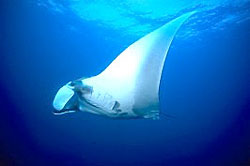
MANTA RAY (Manta birostris)
Width:
to 7 m
The largest ray lives pelagically in the open sea, but is
also observed near reefs at cleaning-stations to allow cleaner
wrasses to remove skin parasites and old skin.
The huge Manta Ray is a filter feeder, like the Whale Shark. It feeds on
plankton and small fish. The prey is guided into the enormous
mouth by a fleshy lobe on each side of the head.
Manta Rays feed close to the surface, where plankton tends to accumulate.
In the process, the rays execute somersaults and even break the surface.
They can sometimes be observed jumping high out of the water. What may appear to be playing is usually a form of dominant behavior, or an attempt to shed dermal parasites.
Manta Rays are viviparous and usually give birth to two young after a gestation period of thirteen months.
SPOTTED SHOVELNOSE RAY (Rhynchobatus djiddensis)
Length: to 3.10 m
This fascinating fish is a bridge of sorts between the evolution of sharks and rays. The species lives on sand or coral rubble down to 50 m, and is sometimes seen in extremely shallow water.
They are viviparous with a litter size of about four. They mainly feed on crustaceans and other shelled invertebrates.
Home |
Liveaboard Cruises |
Day Trips |
Diving Courses |
PADI IDC - CDC |
TEC Diving |
Dive&Save |
Reef Guide |
Phuket Guide |
About Dive Asia |
FAQ |
Links |
Contact us



Dive Asia - Phuket Thailand
Office Address: 23/6 Karon Rd, Kata Beach, Phuket 83100, Thailand
Phone: +66 (0) 76330598
Visit us at one of our Offices: (Google Map)
Email:
Website: www.diveasia.com
24 Hour Hotline: +66 (0) 818948588