







Reef Ecology Guide Phuket Thailand - Crustaceans
CRUSTACEANS

The crustaceans are one of the truly dominant groups living on coral reefs. However, due to the tiny size and cryptic habits of many species, it is easy to under-estimate their impact on the reef's ecology.
The group is incredibly diverse with regards to size, shapes, colors and life style. Not only does it include well known representatives such as lobsters, shrimps and crabs, but also a wealth of microscopic organisms that form a large portion of the zooplankton.
Crustaceans are typified by the presence of a calcium carbonate-based external skeleton. Because of continuous growth throughout the life cycle, the animal periodically outgrows its armor coating. Therefore the shell is shed and replaced at regular intervals. When the shell is shed and the new coat is still relatively soft the animal is vulnerable to predators and therefore seeks shelter in a burrow or other hiding place.
Generally the best time to observe crustaceans is at night when many species emerge from their retreats to feed. The most conspicuous crustaceans during daylight hours are those that clean parasites from fishes. The so called cleaner shrimps are frequently bright colored and occupy permanent stations that are regularly visited by a variety of fishes.
WHITE-SPOTTED HERMIT CRAB (Dardanus megistos)
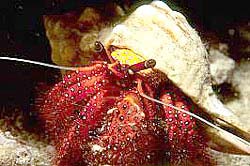
Large species with a max. length of 25 cm. Its soft abdomen is put into an empty snail shell for protection.
Sometimes living with a tiny red and white shrimp as commensally inside the shell. Often seen at the Similan Islands.
PEACOCK MANTIS SHRIMP (Odontodactylus scyllarus)
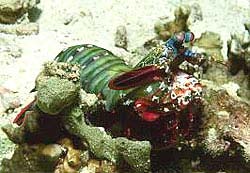
Mantis shrimps are elongated crustaceans with a long, flattened tail.
The Peacock Mantis Shrimp is a very colorful species, feeding on other shrimps, worms and small fishes.
Most conspicuous is a pair of praying mantis-like claws, which are inflated in the terminal segment, an adaptation to crush prey with a strong smash.
DURBAN DANCING SHRIMP (Rhynchocinetes durbanensis)
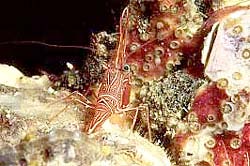
This species lives deep in crevices and holes, usually in large numbers. They are distinct by large, bulging eyes and a humpback.
It is called dancing shrimp because of its unusual way of moving on the ground, which resembles a tango dancer.
BANDED BOXER SHRIMP (Stenopus hispidus)
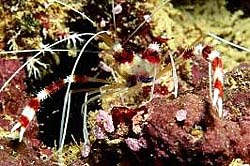
A common cleaner shrimp with spiny, bristly body and legs. The base of the legs are blue.
The species is always found in pairs. Males are much smaller than the females.

Home |
Liveaboard Cruises |
Day Trips |
Diving Courses |
PADI IDC - CDC |
TEC Diving |
Dive&Save |
Reef Guide |
Phuket Guide |
About Dive Asia |
FAQ |
Links |
Contact us





Dive Asia - Phuket Thailand
Office Address: 23/6 Karon Rd, Kata Beach, Phuket 83100, Thailand
Phone: +66 (0) 76330598
Visit us at one of our Offices: (Google Map)
Email:
Website: www.diveasia.com
24 Hour Hotline: +66 (0) 818948588