





Reef Ecology Guide Phuket Thailand - Molluscs
MOLLUSCS

The phylum Mollusc comprises snails and slugs, shells and cephalopods like octopus and squid. With more than 150,000 species they are one of the largest phylums in the animal kingdom.
Molluscs are characterized by a muscular mantle, a tooth-covered rasping tongue and a muscular foot, which may be modified for diverse uses. Most types possess a shell of calcium carbonate that is secreted throughout the lifespan.
However, many molluscs and some cephalopods have lost their shells entirely or it is much reduced. A well-developed set of gills used for respiration is another characteristic of most marine molluscs.
SEA SHELLS
Sea shells are usually burrowers or are attached to the substrate. Because they are unable to actively search for food, most rely on their elaborate gill structure, to filter out tiny plants and animals.
Many species possess microscopic alga cells in their exposed mantles. The alga actually produces food for its host and apparently very little extra nutrients are required. The mantle also contains light and pressure sensitive spots that cause the shell to quickly close its valves if disturbed.
The sex is separate in most molluscs. Sea shells release clouds of eggs and sperm into open water. Somehow, perhaps by sensing changes of temperature or salinity, the spawning of the entire population of a local area is synchronized. The fertilized eggs hatch out as larvae, swimming or drifting in the sea for a period ranging from about 2-40 days, before finally settling on the bottom.
SQUAMOSE GIANT CLAM (Tridacna squamosa)
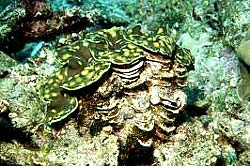 Common in shallow reefs around the Similan Islands and Phuket to about 10 m. Embedded hinge-down in corals, shell with rows of flanges.
This species carries both sexes in its body; eggs and sperm get released at different times to avoid self-fertilization.
THORNY OYSTER (Spondylus varius)
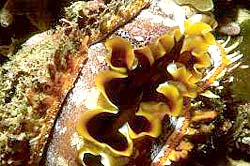 This species has a heavy, almost circular shell. One shell is cemented to the substrate, the other shell is moveable as lid.
Both shells have radial ribs and spines on the outer surface. It rapidly closes when shadowed.
Normally heavy overgrown by various invertebrates.

SNAILS & NUDIBRANCHS
Snails and nudibranchs are by far the most common type of molluscs encountered on coral reefs. Most of the body of a typical sea snail is hidden within its shell, which offers protection from predators.Aside from the shell the only other body part usually seen is the muscular foot. The foot secretes mucus to cut down friction.
The feeding habits are just as variable as their appearance. In contrast to sea snails the evolutionary trend in nudibranchs has been towards a reduction or even complete loss of the protective shell.
The flesh of these bright colored creatures is frequently toxic or distasteful due to various chemical secretions. The bright coloration serves to warn predators of their inedible qualities. The majority of species feed on algae, sponges and cnidarians.
MUREX TRIBULUS
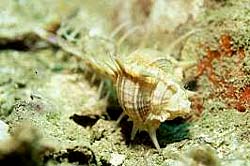 The distinct body shape of the shells of this genus is due to the muddy areas on which it lives.
It feeds on mussels, hidden in sand and mud.
PHYLLIDIA VARICOSA
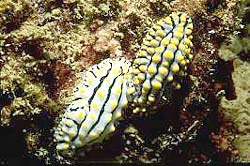 These sea slugs are masters of chemical defense: they are capable of polluting an entire aquarium if stressed in any way.
They produce a strong toxin that can kill all life in the aquarium. They have no known enemies.
CHROMODORIS ANNULATA
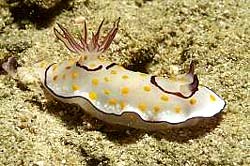 This large nudibranch is mostly found crawling in pairs.
Each animal alternately raises and lowers its head as it crawls. It feeds on sponges.
CEPHALOPODS
Members of this family have the most advanced nervous system of all invertebrate animals. Many live in the open ocean or in abyssal depths. Relatively few species are encountered on coral reefs.
All family members have in common an ability to eject ink, produced by a gland within the fleshy mantle, to deter and escape from potential predators.
Although outwardly cephalopods seem very unique, these animals have the same basic molluscan body plan, but with special modifications. Beside the well-known octopus the other members of this group are cuttlefish, squid and the nautilus.
The eyes of cephalopods are human-like and accurately register shapes, textures and colors. The keen eyesight and well developed brain make them deft hunters, feeding on fish, crustaceans and shelled molluscs.
MARBLED OCTOPUS (Octopus aegina)
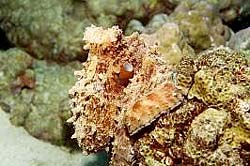 This species can be found down to a depth of at least 40 m duiring dives at the Similan Islands. The nocturnal hunter feeds on crustaceans and shells.
Octopuses have a large brain and are regarded as the most highly developed invertebrates.
PHARAO CUTTLEFISH (Sepia pharaonis)
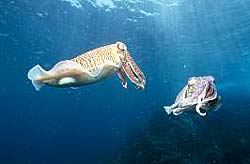 Mostly nocturnal species. During mating and spawning they can also be seen in daytime.
Cuttlefish are well-known for rapid color changes, when disturbed. They feed on crabs and small fishes.
Home |
Liveaboard Cruises |
Day Trips |
Diving Courses |
PADI IDC - CDC |
TEC Diving |
Dive&Save |
Reef Guide |
Phuket Guide |
About Dive Asia |
FAQ |
Links |
Contact us




Dive Asia - Phuket Thailand
Office Address: 23/6 Karon Rd, Kata Beach, Phuket 83100, Thailand
Phone: +66 (0) 76330598
Visit us at one of our Offices: (Google Map)
Email:
Website: www.diveasia.com
24 Hour Hotline: +66 (0) 818948588